
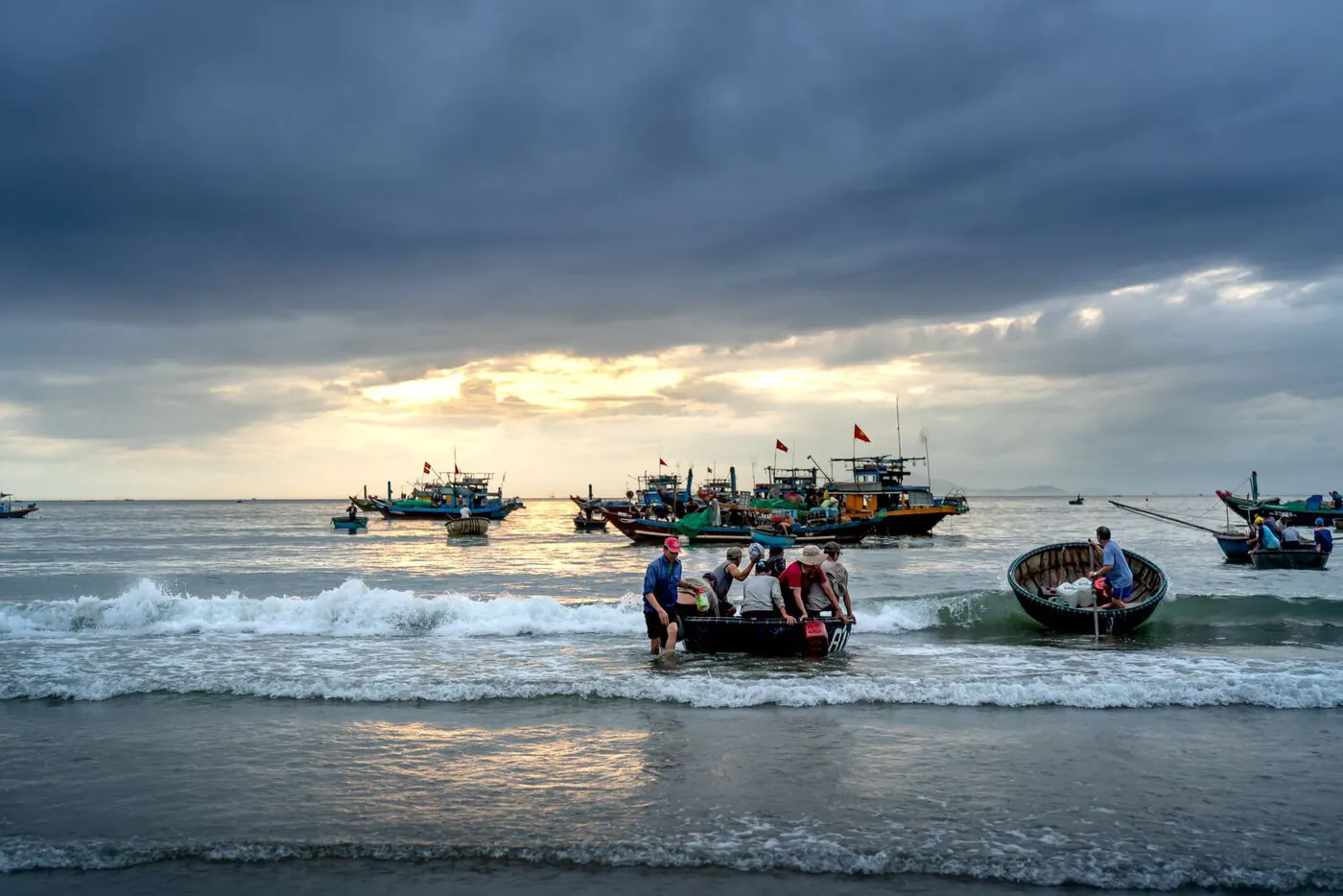
A little before six in the morning, Da Nang is already on its feet. Hundreds of locals are in the sea off My Khe Beach, swimming in the half-dark; tai chi lines form on the sand; up the coast at Man Thai, round bamboo basket boats are hauling in the night's catch. By full light the beach is gym, temple, and open-air fish market at once. Behind all of it stand the cranes.
The skyline is mid-sentence. A city living in several eras at the same time rewards the traveler who arrives while the eras still touch, and in Da Nang they do. The window is closing, though, faster than most people realize.
Everybody has wanted this harbor for two thousand years
Start with how deep the layers go. The bay sits in the heartland of old Champa, the Hindu kingdom that rose along this coast around 192 AD; its temple city at My Son, about an hour's drive southwest, has held UNESCO World Heritage status since 1999. The Museum of Cham Sculpture by the Han River keeps the largest collection of Cham artifacts in the country. The French opened their conquest of Vietnam on this exact waterfront in 1858 and ran the port for decades as Tourane, leaving a riverfront street grid, a governor's palace that now houses the city museum, and a pale pink cathedral finished in 1923.
Then came March 8, 1965: about 3,500 US Marines waded ashore at Red Beach, the first American ground combat troops of the war, and were met, famously and unopposed, by sightseers and girls with flower garlands under a sign reading "Welcome, Gallant Marines." My Khe, the beach the dawn swimmers now own, became "China Beach," one of the war's two great R&R escapes. The Marble Mountains just south hid a Viet Cong field hospital inside Huyen Khong cave, within earshot of the American airbase. The city was liberated on March 29, 1975.
Da Nang remembers all of this in concrete and steel. The Han River swing bridge, opened in 2000 and funded partly by donations from the city's own residents, rotates in the small hours to let ships through. The Dragon Bridge was deliberately opened to traffic on the 38th anniversary of the city's liberation: 666 meters of steel dragon, six lanes of commuters by day, and on weekend nights at nine it breathes actual fire over the river while the night market trades under its head.
Stalled shells, new islands, one enormous merger
The modern arc starts in 1997, when Da Nang split from its province to answer directly to the national government. On July 1, 2025, Vietnam ran the largest administrative restructuring in its history, folding 63 provinces and cities into 34, and merged the whole of Quang Nam province into Da Nang. Hoi An, the UNESCO trading port 30 kilometers down the coast, now sits officially inside the city, which spans roughly 12,000 square kilometers and holds about three million people.
The same year brought a national mandate for an international financial center and Vietnam's first free trade zone. The economy grew 9.18 percent in 2025, the city's fastest in five years. The announced ambition now runs to five artificial islands in the bay, added to the public investment plans in April 2025.
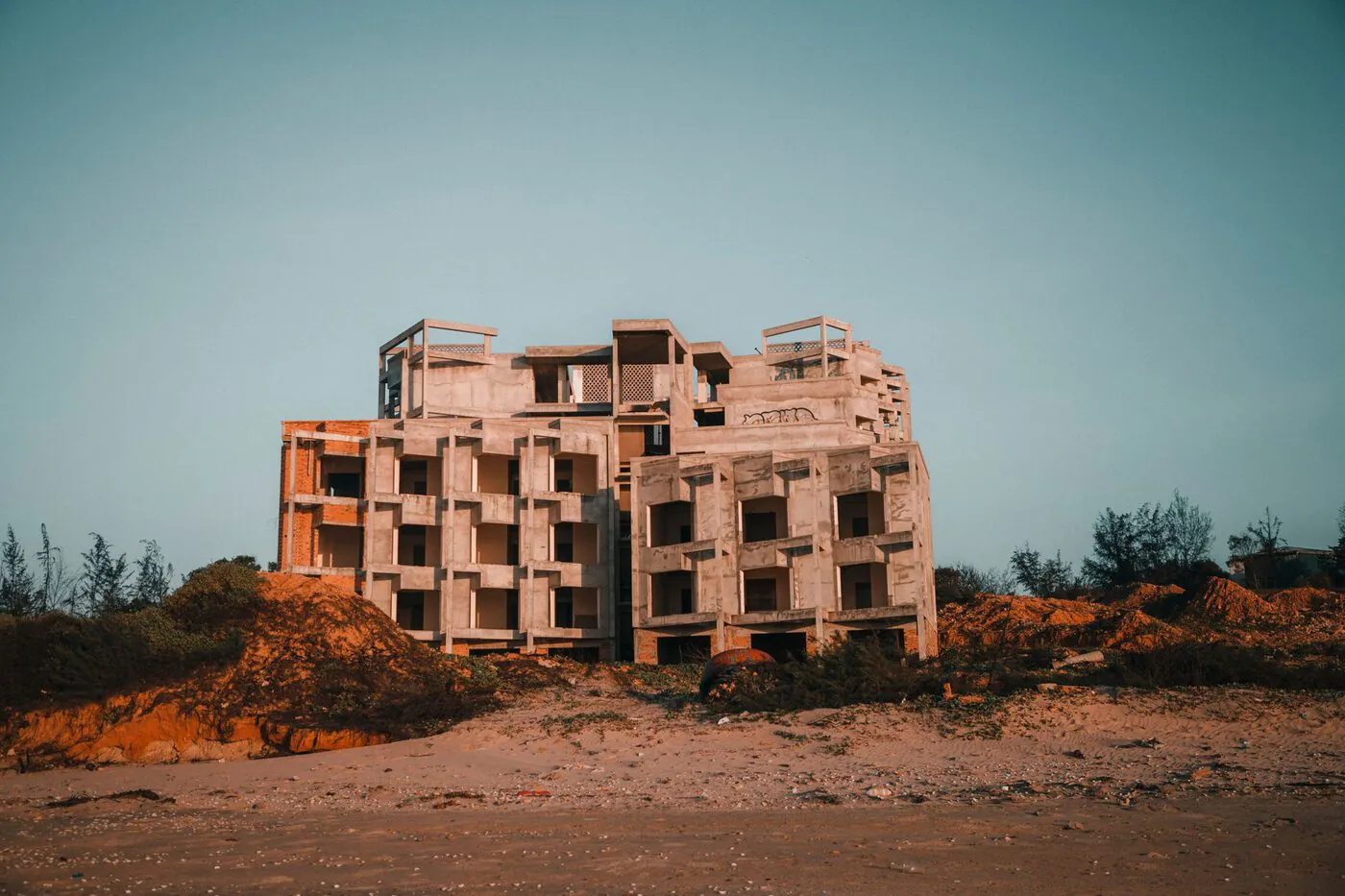
The other layer is just as visible. Ride the coastal strip toward Hoi An and you pass Cocobay, the 470-million-dollar leisure city that broke ground in 2016 with Cristiano Ronaldo as its ambassador, publicly failed on its promised 12 percent returns in 2019, and stands today in quiet rows of unfinished condotel shells. A 2024 report counted as many as 1,200 delayed projects across the city, some stalled for more than ten years, even as dormant ones come back to life. Thuan Phuoc, 97 hectares the city reclaimed from the sea at the foot of its own bridge, sat under grass for years before a groundbreaking was finally reported in 2025.
Even the amusement park closed, in September 2025 after eleven years, its 115-meter Sun Wheel still standing over land its developer has earmarked for central Vietnam's tallest tower. Downtown, the surviving French villas keep disappearing into subdivision and demolition, and the old collective housing blocks, the khu tap the, are being cleared block by block. Out at Nam O in 2018, residents fought a resort developer's fence until the city carved five public paths back to their beach. Boom and ruin are not taking turns in Da Nang; they share street frontage.
From fish-sauce village to Monkey Mountain in one day
All of it reads from a public road, which is the point. (The famous abandoned water park with the dragon head, star of every Vietnam urbex reel, sits two hours north outside Hue; Da Nang's wreckage is newer and stranger.) Urban exploration in this city asks for a rented scooter, a free day, and a tolerance for getting pleasantly lost; the fenced sites stay fenced, because the shells tell their story from the street. One practical note before you ride: check that your home license is actually valid in Vietnam, because for many nationalities, Americans and Australians included, it is not, and your travel insurance follows the license.
Start at the north end of the bay. Nam O, the village that defended its beach paths, has fermented black anchovies with sea salt in clay jars for over 400 years, 12 to 18 months a batch, a craft Vietnam listed as national intangible heritage in 2019. In winter the reef off the village throws a fast, sharp left-hander that experienced surfers drive up for, and above the village the Hai Van Pass climbs 21 kilometers over the mountains, the highest coastal road in the country.
Come back through the center hungry. Con Market, trading on its sand dune since 1940, beats the more famous Han Market for food: mi quang, the region's turmeric-yellow noodles; banh xeo sizzling in its rice-flour lace; salt coffee, a Hue invention the rest of central Vietnam adopted, dripping through a phin under lightly salted cream.
South of My Khe, the An Thuong grid of numbered streets holds the coworking cafes and craft-beer taps of the nomad wave that put Da Nang on Forbes' 2026 list of the world's top cities for remote workers. It is a comfortable landing pad, and you should walk out of it quickly.
Past An Thuong rise the Marble Mountains, five limestone hills named for the five elements. Across the water the 67-meter Lady Buddha faces the sea from Son Tra, the peninsula American soldiers called Monkey Mountain, where about 1,300 red-shanked douc langurs, among the rarest primates on earth, live in the forest above the city. The whole run, Nam O to the mountains, fits inside one day.
Da Nang's underground is young enough to walk into
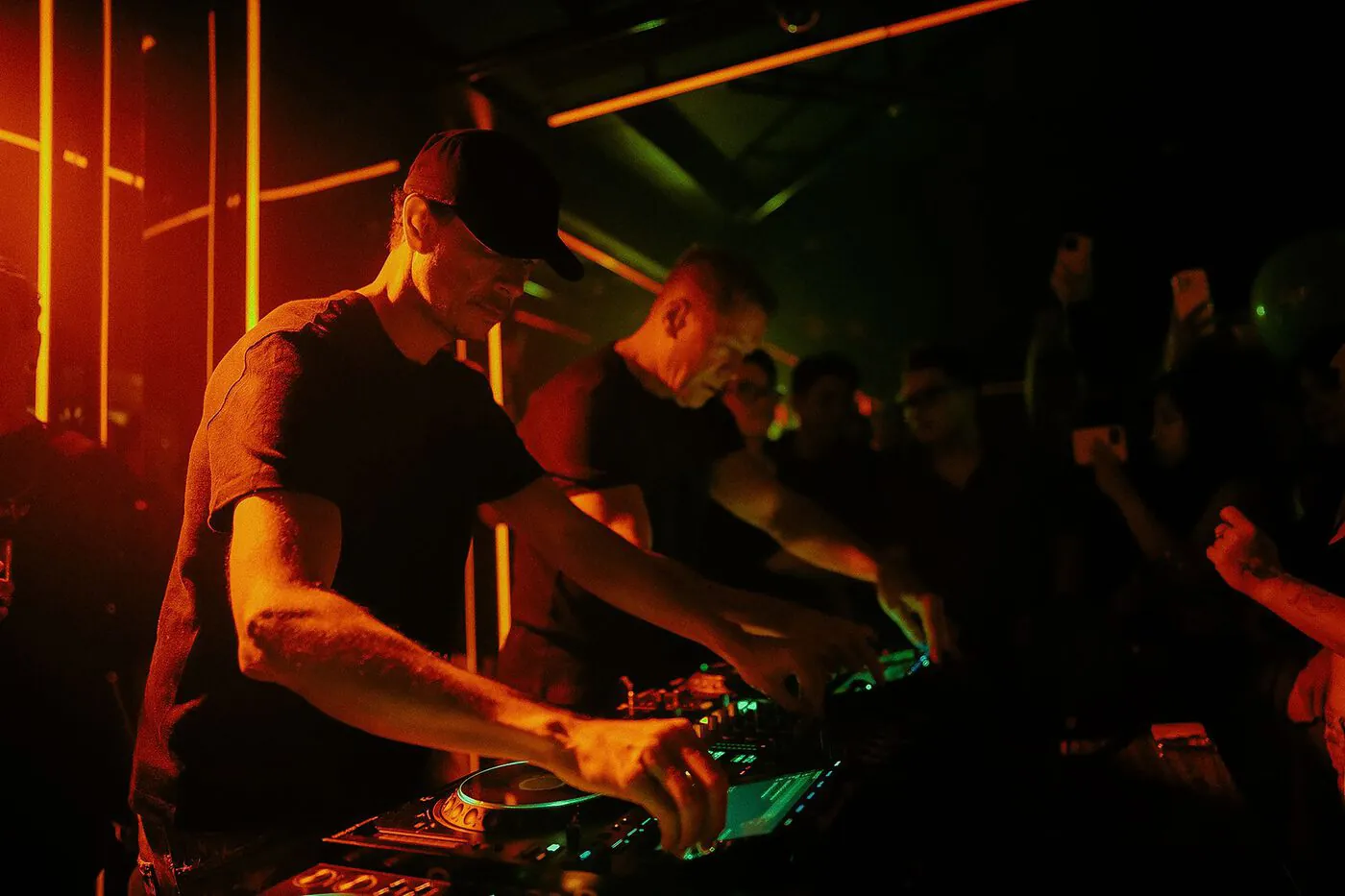
Da Nang runs two nightlifes. The tourist one, rooftop hotel bars and big beach-road clubs, finds you on its own. The one worth your evening took root around 2019: SAGA, in the An Thuong streets, runs a dedicated techno room built on long sets and dancefloor proximity, and Gatosano keeps a vinyl-shop cafe by day and a weekend club room that visitors describe reaching through a butcher shop.
The crews are documented, and the press arc shows the direction of travel. Gatosano's promoter family, PMC, carried its Japonism festival onto the Lang Co mountainside of the Hai Van Pass in September 2024, running three days and two stages with more than thirty DJs. Mixmag Asia credited the crew with igniting "a new wave of energy in the Da Nang and Hoi An music scene."
The same magazine had called Da Nang "coming up as a new destination in Vietnam for fans of house and techno" in 2021; by 2024 it was writing of the city being brought "up to the level of other Vietnamese cities." Saigon has The Observatory, a decade old and the country's house-and-techno anchor, and Hanoi has Savage, the capital's underground hub since 2016. Da Nang is the third city, the young one, and that is exactly the appeal: the rooms are small, the people building the scene are findable, and a stranger who cares about the music gets folded in within a weekend.
Radio joined in November 2024, when Da Nang Community Radio went on air with six DJs broadcasting from The Roof, the city's entry in the loose constellation of underground stations rising across Asia right now. Hoi An, down the coast, has run an underground scene of its own for years: Sonic!, Rumor Events, Bass2Face, Halcyon, and the Cham Chi club have all been putting on events there regularly, long before the festival chose the place.
Four days in August, two towns, one city
This is the city Airtime Asia chose, and the timing is the argument. We are an independent, decentralized media coalition of underground radio platforms from across Asia, and from August 13 to 16, 2026, we bring over a dozen of those stations to Da Nang and Hoi An, one city on paper since last July, two textures on the ground.
The festival runs through the city's existing rooms, the cafes, venues, and beaches this piece has been walking through. On the Friday night, eight walkable venues in the center of Da Nang each become a pavilion programmed by one partner station. On the Saturday the coalition moves down the coast to Hoi An and spends the night moving across the town's settings: a meal in the rice paddies; a set on An Bang Beach; a riverside clubhouse that looks carved straight out of the rock. The lineup lands closer to the date.
If the case for the city is the overlap, the case for August is that you get all of it at once: the dawn swimmers and the stalled shells; the fish-sauce village and the financial center; a young underground with the whole region's constellation in town. Come early, give Da Nang a day or two of wandering before the first set, and stand in the overlap while it is still open.
Feed your mind with high frequency vibrations. Join us in the Airtime.
 End of transmission